The problem
Rocket and jet nozzles depend on choked flow, where the throat hits the speed of sound and the flow can’t increase any further.
Compressible flow · ME 347 · Cal Poly
With a team of four, I ramped up a compressor until the flow through a nozzle’s throat choked at Mach 1, then solved a data anomaly that seemed to say the flow had gone supersonic.
The problem
Rocket and jet nozzles depend on choked flow, where the throat hits the speed of sound and the flow can’t increase any further.
What I did
Measured pressure at three points across compressor settings and compared two flow models.
The result
Pinpointed choking with a measured pressure ratio of 0.537 vs. 0.528 in theory, and traced the “supersonic” reading to the sensor’s true location.
Placed pressure sensors at the inlet, throat, and outlet.
Raised the flow and watched the throat pressure drop toward the limit.
Showed the compressible model beats the simple one at high speed.
Used two plots and physics limits to explain an “impossible” reading.
Worked with a team of four on this lab, and I tested a converging-diverging nozzle across a series of compressor settings. We used pressure ratios to identify choking, calculated throat Mach number, and compared incompressible and compressible one-dimensional models.
Three pressure stations across a controlled restriction
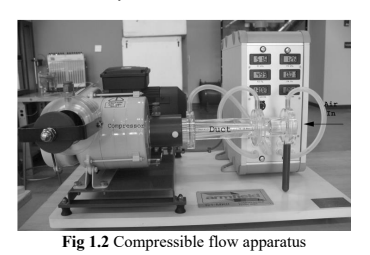
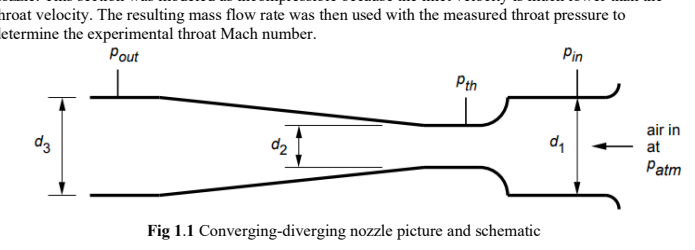
A four-stage centrifugal compressor pulled air through the nozzle. Pressure transducers measured vacuum pressure at the inlet, throat, and outlet while atmospheric pressure and temperature established the absolute reference and air properties.
The measured throat diameter was 9.481 mm, smaller than the nominal 10 mm. Retaining both dimensions in the analysis helped separate geometry sensitivity from model behavior.
The throat records the largest static-pressure drop
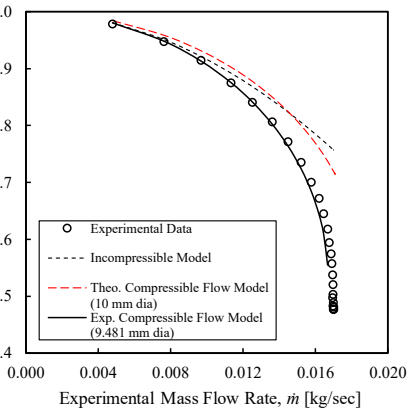
Increasing compressor speed raised mass flow and accelerated the air through the converging section. The inlet remained near atmospheric pressure while the throat pressure ratio fell sharply toward the critical value.
The experimental trend followed the compressible model more closely as velocity increased. Density variation became important enough that the constant-density model could no longer represent the flow accurately.
Mass flow levels off as the throat approaches Mach 1
Choking appeared near a mass flow of 0.0170 kg/s. The corresponding measured throat pressure ratio was approximately 0.537, close to the theoretical critical ratio of 0.528 for air with k = 1.4.
An audible change in the flow and the leveling of mass flow provided independent experimental evidence that the throat had reached sonic conditions.
Model divergence grows with Mach number
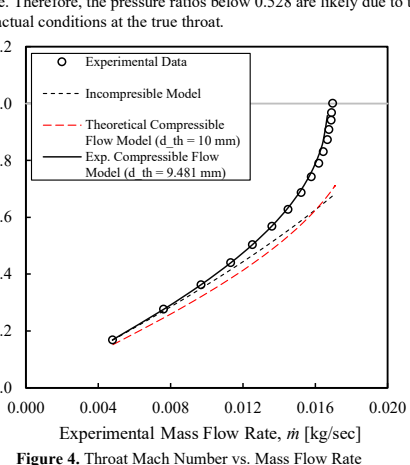
The incompressible and compressible predictions began separating by roughly 3-5% near Mach 0.44. At higher speeds, density changes could no longer be neglected.
The measured-diameter compressible model tracked the experimental data best and approached Mach 1 at the same flow rate identified from the pressure-ratio plot.
A measurement-location issue explained an impossible throat value
At the highest compressor settings, the measured pressure ratio dropped below 0.528 and the direct calculation returned Mach numbers slightly above one. That result cannot describe the true minimum-area throat, where choked flow should remain at Mach 1.
The most likely explanation is that the labeled throat pressure tap sits slightly downstream in the diverging section. There, the flow can continue accelerating and static pressure can fall below the true throat value.