Bottling Station
SolidWorks assembly and motion analysis
This project brought a collection of individual SolidWorks components together into a coordinated mechanical system. I assembled the station, constrained its moving parts, and built a motion study to evaluate how bottles advance through an indexed operating sequence.
System architecture
From individual components to one coordinated assembly
The station centers on a rotating indexing mechanism that moves bottles between operating positions. The frame, guides, rotating plate, and surrounding mechanisms must share a common layout so each bottle arrives at the next stage in a predictable position.
Rather than treating each component as an isolated model, the assembly was organized around the bottle path and the interfaces between moving parts. This made the system sequence easier to understand and exposed alignment dependencies early.
Assembly and constraint strategy
Controlling motion without over-constraining the model
The primary modeling task was defining how the supplied parts relate to one another. SolidWorks mates established the fixed structure, located rotating components on their axes, and preserved only the degrees of freedom needed for the mechanism to cycle.
Building the assembly in functional groups made troubleshooting more manageable. Each mechanism could be checked locally before it was evaluated as part of the full station, reducing the chance that one incorrect mate would lock or destabilize the entire model.
Motion study and verification
Evaluating interaction across a complete operating cycle
Once the assembly behavior was defined, I created a motion study to drive the indexing sequence and observe the parts as a system. The animation made it possible to review timing, alignment, clearances, and component interaction in a way that a static model could not.
The study also served as a communication tool. Watching the mechanism cycle makes the station's intended operation immediately understandable and provides a repeatable way to review problem areas before committing to a physical build.
Engineering communication
Explaining both geometry and behavior
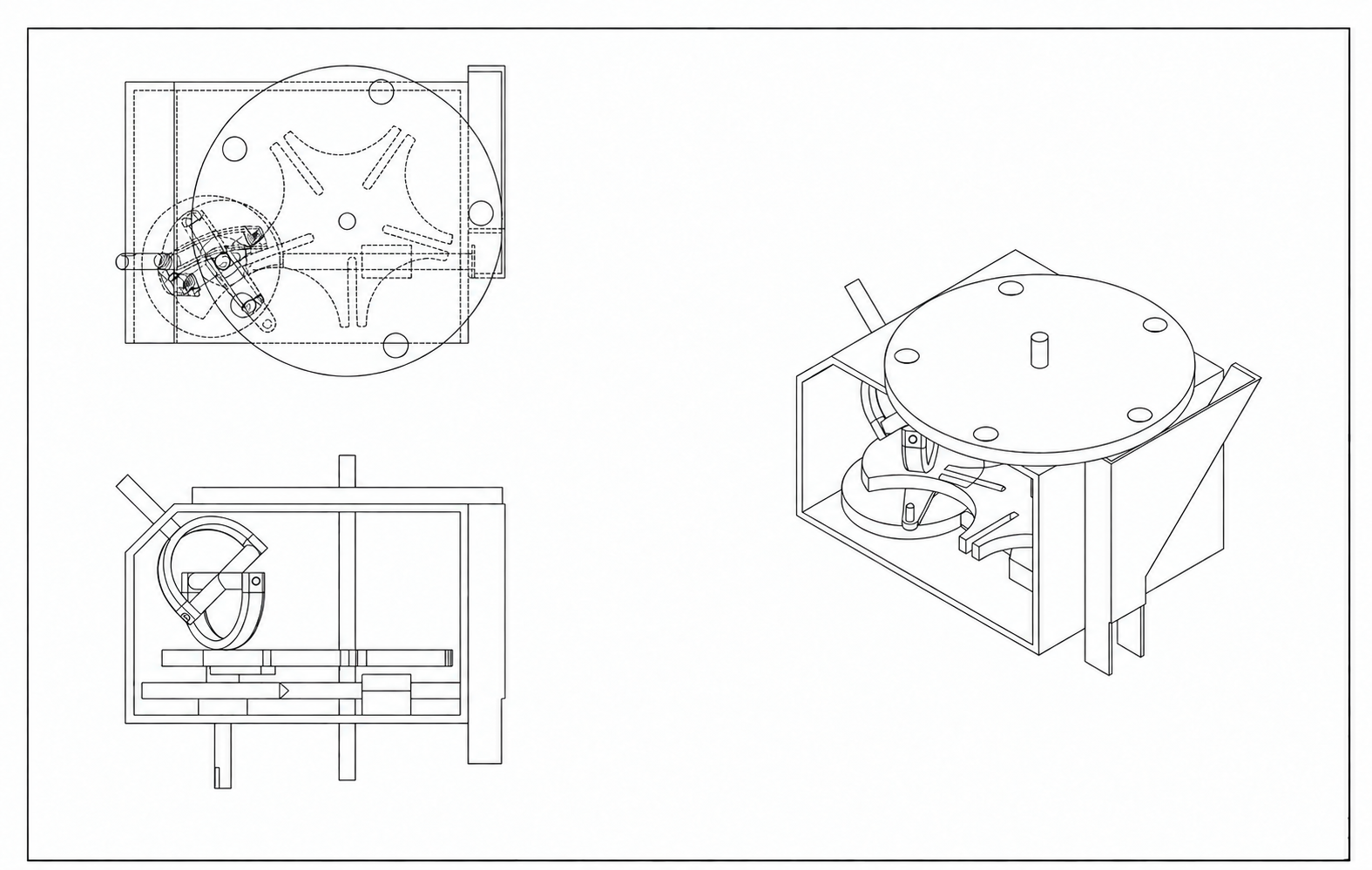
The final deliverables pair conventional drawing views with the motion study. The drawing documents the overall arrangement from multiple perspectives, while the animation explains the sequence and interaction that cannot be captured on a single sheet.
This project strengthened my understanding of assembly hierarchy, mechanical mates, motion studies, and system-level verification. Most importantly, it reinforced that a successful digital assembly must communicate how the design behaves as clearly as it communicates what the design looks like.